When Your Client Drops an F-Bomb: Newsletter Marketing That Actually Works
Note: This post was originally written during my Virtual Assistant and Online Business Manager era. It has since been updated for 2026 to reflect the current direction of my work as a Growth Operator. If you came looking for the original version, the core story is still here, but the language has been refreshed to better reflect how I support small business owners today.
—
There are moments in business that stop you in your tracks.
The kind that make all the hours, drafts, deadlines, strategy, revisions, and behind-the-scenes work worth it.
For me, that moment came in a text message that read, with a few words blurred out for professionalism:
“Gawd the newsletters are so f***ing good.”
“I f***ing LOVE.”
“If people really realized how much GEMS are in there omg.”
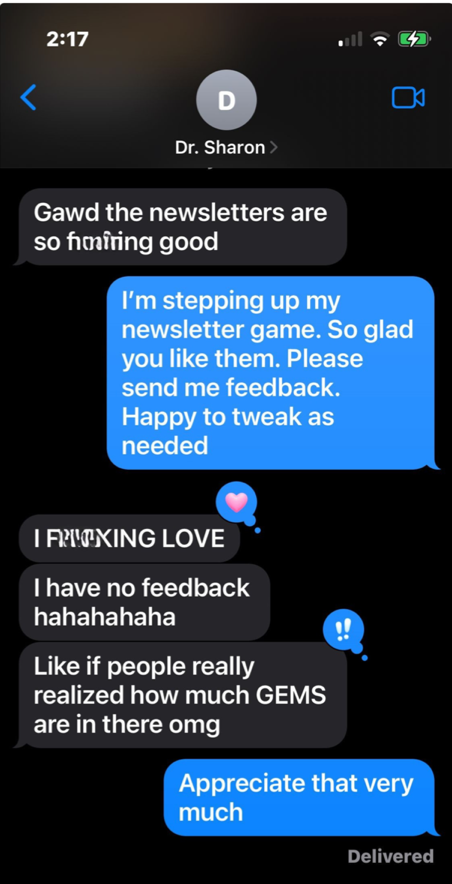
I laughed out loud, then took a screenshot.
Because that is what every service provider hopes to hear: that the work you create is not just good, but so useful, aligned, and valuable that it creates a real emotional reaction.
And in this case, the reaction was about newsletters.
Not a flashy launch.
Not a viral post.
Not a perfectly polished brand campaign.
Newsletters.
The unsexy, consistent, relationship-building marketing channel that still works when it is done well.
For the past two years, I have produced two newsletters every week for Dr. Sharon Elefant of The Nonprofit Plug. Each issue delivers practical insights, curated grant opportunities, and genuinely useful tools for nonprofit leaders trying to make an impact.
That is more than 200 newsletters, all crafted to inform, inspire, and move readers toward action.
But the real lesson is not just that newsletters work.
The lesson is that consistency becomes powerful when it is connected to strategy.
During my Virtual Assistant era, newsletter support might have looked like formatting, scheduling, and getting the email out the door. As my work evolved into Online Business Manager support, the focus expanded into planning, coordination, calendars, and keeping the process moving.
Today, as a Growth Operator, I see newsletter marketing as part of a larger business system.
Because a newsletter should not just “go out.”
It should support visibility, build trust, reinforce positioning, guide the reader toward a clear next step, and connect back to your website, offers, analytics, and overall growth strategy.
That is where the real value lives.
Why Newsletters Still Matter
In a world obsessed with algorithms, newsletters remain one of the strongest tools for high-touch marketing.
They give you direct access to people who have already said, “Yes, I want to hear from you.”
That matters.
Social media can create visibility, but email helps nurture trust.
A thoughtful newsletter gives your audience a reason to keep paying attention. It allows you to educate, encourage, clarify, and stay top-of-mind without relying on a platform you do not control.
Here is why newsletters still work:
1. Direct Connection
You are landing in someone’s inbox, not hoping they happen to see you in a crowded feed.
There is no algorithm deciding whether your audience gets the message.
When someone opens your email, you have a direct line of communication. That does not mean every subscriber will read every issue, but it does mean you are building on a channel that belongs much more to you than social media ever will.
2. Authority and Trust
Consistent, useful newsletters build credibility over time.
When you show up with practical insight, relevant resources, and a clear point of view, people begin to associate your business with reliability.
They start to see you as someone who understands their world.
That trust compounds.
Not because you are shouting the loudest, but because you are showing up with value again and again.
3. Relationship Nurturing
A good newsletter keeps your brand top-of-mind without feeling pushy.
It says, “I am here, I understand what you are navigating, and I have something useful to offer.”
That is high-touch marketing.
Not constant selling.
Not generic updates.
Not content for the sake of content.
It is a relationship-building rhythm that helps your audience feel seen, supported, and more ready to take the next step when the timing is right.
4. Long-Game ROI
Newsletters may not always convert instantly.
That does not mean they are not working.
Some people need to read for weeks or months before they reach out. Some need to see you consistently before they trust you. Some may forward your email to someone else who becomes the right client, donor, partner, or referral.
That is the long game.
And in a business where trust matters, the long game is often where the best opportunities come from.
The Secret Sauce: Relevance and Consistency
What makes a newsletter effective is not just good writing.
It is relevance.
Every issue I produce for clients like Dr. Sharon is built around what their audience actually cares about right now.
For The Nonprofit Plug, that means nonprofit leaders are not just receiving a random inspirational email. They are getting timely guidance, grant opportunities, compliance reminders, leadership perspective, and practical tools that connect to the real pressures of running and growing a nonprofit.
That level of relevance takes more than writing.
It requires strategy.
It requires understanding the audience.
It requires knowing what the business is trying to accomplish.
It requires paying attention to timing, seasonality, offers, analytics, and the next step you want the reader to take.
Pair that with consistency, twice a week, every week, for more than two years, and you are no longer just sending emails.
You are building a brand asset.
One issue may not change everything.
But a well-built newsletter system creates compound interest.
Your audience becomes more familiar with your voice. They understand your value. They see your consistency. They start to trust that you know what you are talking about.
And when they are ready, you are already in their inbox.
Newsletters Work Best When They Are Connected to the Bigger Picture
This is where many small business owners miss the opportunity.
They think of newsletters as one more marketing task.
Write the email. Send the email. Move on.
But a newsletter can do much more when it is connected to the rest of the business.
A strong newsletter strategy can support:
brand positioning
website traffic
service inquiries
discovery calls
donor engagement
client education
content repurposing
audience research
offer refinement
long-term relationship building
The newsletter becomes more than a weekly task.
It becomes a signal.
What people click tells you what they care about.
What they reply to tells you what resonates.
What gets forwarded tells you what is useful.
What leads to calls, donations, purchases, or inquiries tells you where the message is working.
That is why I do not look at newsletter marketing in isolation.
As a Growth Operator, I look at how the newsletter connects to the website, the call-to-action, the analytics, the client journey, and the operational system behind it.
Because sending the newsletter is only one part of the work.
The bigger question is:
What is the newsletter helping the business do?
The Takeaway
If a client is dropping expletives out of pure joy, it is probably because the work is doing what it is supposed to do.
It is connecting.
It is clarifying.
It is giving the audience something useful.
It is helping the business show up with consistency and authority.
That is what strong newsletter marketing can do when it is built with intention.
Not as a random content task.
Not as a rushed weekly obligation.
But as part of a larger marketing and growth system.
If your newsletters feel disconnected, inconsistent, or unclear, the answer is not always to send more emails.
Sometimes the answer is to step back and ask whether your message, audience, offer, website, and follow-up process are actually working together.
That is the kind of work I do now at Mia Borja LLC.
My work has evolved from Virtual Assistant to Online Business Manager to Growth Operator, but the goal has stayed the same:
helping business owners create structure, strengthen relationships, and build a digital presence that supports sustainable growth.
Because marketing works better when the pieces are connected.
About Mia
Hi, I’m Mia Borja, a Growth Operator based in California. My work evolved from Online Business Manager and Executive Virtual Assistant support into a more integrated role that combines strategy, systems, websites, operations, and hands-on implementation.
I help solopreneurs and founders clean up the messy middle of their business: the disconnected systems, inconsistent marketing, unclear client journeys, and backend workflows that make growth harder than it needs to be.
After nearly two decades in executive-level roles, I’ve learned that real business growth does not come from chasing more platforms, more followers, or more complexity. It comes from building a clear foundation, nurturing the relationships you already have, and creating systems that help your business show up consistently.
Whether I’m refining a website, improving a newsletter strategy, organizing backend operations, or connecting the tools behind the scenes, my goal is simple: help you build a business that runs more smoothly, shows up more clearly, and grows with more intention.
Learn more: About | Facebook | Instagram | LinkedIn | Book a Call